
Tangled Threads
For those of you who know me personally, you’re already familiar with my penchant for sparkle. Sequins, glitter, rhinestones, crystals, disco balls, fireworks—I’m a magpie.
Some of that instinct comes with a story my family told using a word I’ve since learned to hold more carefully: “gypsy.” A quick note on language: I use the word here because it’s what my family used when they told this story. It’s not a term I use lightly now—or one I’m trying to celebrate—but it’s part of the lens I inherited. In our version, it meant something almost magical—intuition, mystery, a kind of knowing that didn’t need explaining. It felt powerful, even glamorous, and for a long time, I didn’t question it.
Looking back, I can trace both the sparkle and the mystique to a single moment—one that, in hindsight, feels almost cinematic, the kind that changes you without asking permission.
My mother worked at her best friend Gerry’s beauty salon in Chambersburg, on Roebling Avenue. I can still smell the peroxide and Aqua Net, hear the laughter and chatter of neighborhood clients, feel the stiff fabric of her white uniform. But what I remember most are the chairs.
Every chair—at each station, beneath the oversized dryers, even at the reception desk—was upholstered in glitter-infused scarlet vinyl, so glossy it looked almost liquid. When the light hit, the surface shimmered with a fine, prismatic sparkle, like diamonds or the gleam of Dorothy’s ruby slippers. I was transfixed.
I’d rush to the chairs, practically bouncing, waiting for someone to stand—just long enough to spin one. The moment it turned, the glittered vinyl caught the light and flared into constellations. It felt like magic. I could have stood there for hours, watching the red shimmer swirl and dance.
I remember once being passively scolded by a client with sharp features and sky-blue eyeshadow, who was not pleased that her chair had become a whirlwind when she got up for coffee. Her teased blonde bouffant seemed to reach the popcorn ceiling, towering over my tiny frame. “What is wrong with this kid?” she asked, Styrofoam cup in hand, to no one in particular.
She was right. Did no one find it odd that a four-year-old would stand there for minutes, spinning chairs just to make them sparkle? Honestly, if I saw that in someone today, I’d probably be a little concerned.
That early love of glitter naturally parlayed into an obsession with jewelry. I often carted around a round blue American Tourister train case filled with discarded costume pieces from my mother and grandmother, layering myself in sparkles. It was kismet that I would end up working in the jewelry industry.
Long before DNA kits arrived in neat little boxes, ready to unravel decades of family mythology—we relied on stories, half-truths, and sometimes silence. When I was younger, ethnic pride wasn’t just about heritage—it was a personality trait.
And being Italian? That was especially cool. Heritage wasn’t discussed—it was felt in clattering silverware, garlic and basil in the air, and the taste of Sunday gravy. We didn’t need DNA tests to know who we were.
What we called “Italian” was really Italian-American—inheritance rewritten. Louder, heavier, ours. Not authentic, but true where it counted.
It took nearly fifty years to realize the story I’d been living—so comfortably, so proudly—was incomplete.
It turns out, the sparkle was real.
My great-grandmother Angelina had an uncanny gift for prediction, one she passed down to her eldest daughter, Mary—my paternal grandmother. Both women trusted their intuition, an instinctive sense of knowing. I was told this gift came from Angelina’s mother, my great-great-grandmother Marie. But there was one crucial detail I hadn’t been told: Marie was what my family called a “gypsy,” from Albania.
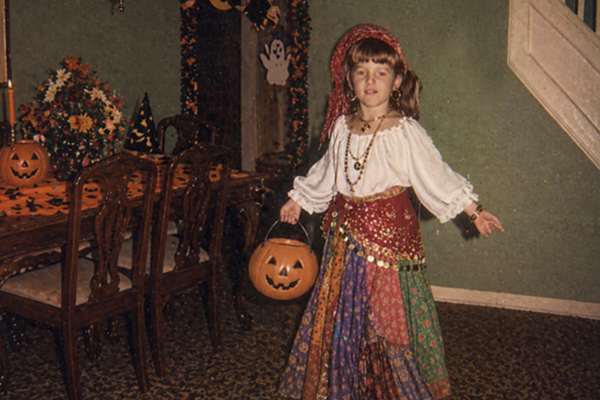
I was obsessed with the inherited version of “gypsy”—a romanticized, mystical figure I didn’t yet have the language to question. Jewelry layered on skin, skirts flashing with coins and sequins, fabric moving like spellwork. Not mildly interested—fully, unapologetically obsessed. I dressed as a “gypsy” for Halloween five times. Five. That’s not a phase—that’s commitment.
I was drawn to women who trusted instinct over instruction—stacked in rings, wrapped in layers, unapologetically intuitive. I didn’t just admire it; I believed in it. I collected pieces of it—music, clothes, attitudes.
What I didn’t realize was how little it had to do with real lives—how much of it was inherited fantasy. The scarves, the mystique, the promise of intuition and fate—women who simply knew. Pop culture kept amplifying it: Cher singing it, Heart styling it on an album cover, Stevie Nicks embodying it in lace and layers.
I once asked for a crystal ball for my birthday. My grandmother Delphine—who wasn’t even from that side of the family—bought me one. I still have it—catching the sunlight on a shelf, heavy with unmet expectations.
And honestly—how did no one see the pattern? At what point does a child ask for a crystal ball and dress as a “gypsy” five times, and no one thinks to offer a little context?
I learned the truth at a family birthday party in my late forties—a setting almost too on-the-nose for that kind of revelation.
A group of distant cousins stood nearby, talking animatedly about “the gypsy,” using the word the way it had always been used in my family. The gypsy this, the gypsy that. Since it’s not exactly a word you hear every day—unless you’re actively consulting tarot—I leaned in.
They told the story of a young man in the Italian army, sent across the Adriatic to Albania during wartime. There, he fell in love with a young woman they described as a “gypsy.” When his service ended, she returned with him to Italy, married him, and eventually sailed with him to America.
That’s when it hit me—that unmistakable, sinking oh no. They were talking about my great-grandmother Angelina’s parents. I nearly dropped my cake.
I turned to my grandmother. “Is this true? She was a ‘gypsy’?”
Unfazed, Mary laughed and patted my hand. “Oh, Danielle—you didn’t know?”
Suddenly, everything clicked—the predictions, the intuition, the lifelong pull. Even the crystal ball, sitting smugly on its shelf, seemed to whisper, I tried to tell you.
What stayed with me wasn’t just the shock of discovery, but the realization that identity is shaped as much by what’s left out as by what we’re told. For decades, I wore “Italian” like a finished label, unaware of the loose thread beneath it. Heritage isn’t always a tidy story passed down in sequence; sometimes it arrives sideways—overheard at a birthday party, a forkful of cake suspended midair.
What once felt like a simple label now feels more like a patchwork—messier, layered, and far more interesting than I ever understood it to be.
And maybe the most romanticized part of the story I inherited wasn’t the scarves or the crystal ball—it was the idea that identity could be singular, fixed. It isn’t. It’s complicated, shifting, and far less neat than we’re taught to believe.
When I finally took the plunge and bought an ancestry kit, I expected a trace of rogue Scot or Irish to explain the red hair in the family. Instead, the results came back 93% Italian, pinpointed to surprisingly precise regions, and 7% Southern European, including traces from the Balkans, where Albania sits.
It was enough to make me smile.
I wasn’t just hearing about Marie anymore—I was, in some strange way, meeting her again. The same threads of mystery stretching back through her, still weaving forward into me.
As I looked at the 7% sliver in the colorful pie chart of my DNA, I whispered, “Hi, Marie.”
Danielle Barber
Author’s Note: This blog supports a memoir-in-progress. The essays published here stand on their own and do not represent the full narrative, which continues to unfold.