
The Djinn in the House
The Djinn in the House
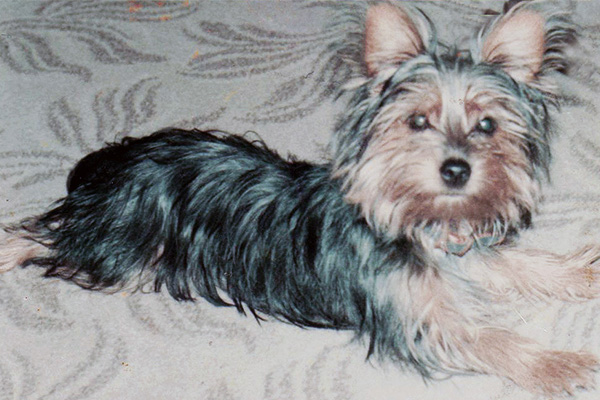
We bonded the moment I stepped into the warm coziness of the breeder’s kennel on a gray November day, my parents at my side. Among so many puppies, she leapt toward me on her small, unsteady legs—tiny, unkempt, already fearless. Her coat, brushy and dark, wasn’t yet the long, flowing silk typical of her breed. I scooped her up, and she nuzzled under my chin as if she already knew me, promptly falling asleep. My parents clutched their chests. That was it—she came home with us that afternoon.
Gin Gin.
She was named after the sometimes invisible, uniform-despising dog from I Dream of Jeannie. At the time, we spelled it “Gin Gin,” exactly as we heard it. Nearly fifty years later, searching for clips online, I discovered that Jeannie’s dog’s name was actually spelled “Djinn Djinn.”
How could we have known? The word djinn was not exactly part of our lexicon in Trenton in those days. The closest we came was Dijon—the fancy mustard reserved for Bonnie’s puff pastry cocktail weenies. As it turns out, a djinn, in Arabian folklore, is a shape-shifting being—mischievous or benevolent, depending on its mood.
The discovery felt less like trivia and more like a diagnosis.
Gin Gin was eight pounds of Doberman attitude crammed into a Yorkshire Terrier frame—low to the floor, utterly unafraid. She moved through the house like a dare, chin lifted, bright eyes locked on anyone—especially my mother—who thought they could stop her. Authority meant nothing to her; rules were merely suggestions issued by taller creatures.
She never submitted to the long, ribbon-festooned look expected of her breed, remaining stubbornly tousled no matter how often we brushed her. Size seemed not to register with her at all. She marched straight up to dogs three times larger, head high, as if issuing a challenge. We held our breath. They backed down.
At home, her moods could turn just as quickly. One moment she darted from room to room, a streak of wiry energy; the next, she stood her ground, lip curling to reveal a single, needle-sharp fang. It was less a threat than a declaration: she would not be managed. Then she would fold herself into an impossibly tight space beside me while I read, as if she had always belonged there.
Looking back, it is hard not to think we named her more accurately than we knew.
Daily life became a running series of standoffs between my mother and Gin Gin. She got into everything forbidden—toppling stacks of papers, shredding what she found, chewing through pillows. When displeased, she kicked back her hind legs like an outraged little bull, ears flattened, tail snapping.
My mother, drawn taut with exasperation, faced her like a matador—poised, unyielding—while Gin Gin charged and feinted, their confrontations taking on the air of something faintly mythic.
Bonnie—precise and composed in every other arena—would finally snap. Blue-violet eyes narrowing, she threw down a gauntlet: “Do not test me, Gin-Gin.”
And there she was, arguing in earnest with eight pounds of fur. My grandfather and I once clocked a stare-down between the two of them that lasted just over a minute.
Mischievous, randy, and entirely sincere in her affections, Gin Gin liked who she liked—end of story. The first time my boyfriend—later my husband—Pablo met my parents, she set her tiny sights on him, stationing herself beneath the dining table and repeatedly launching herself at his leg. At first, we couldn’t understand why he was shaking. Then, one by one, we did—and no one quite knew where to look.
Pablo was far too polite—downright embarrassed—to explain. He shifted chairs, crossed his legs, attempted subtle evasions. Gin Gin remained undeterred, following him into the family room for espresso and my mother’s famous biscotti.
Ever gracious, he took his dessert standing by the fireplace rather than risk another amorous attack.
She even waged a long campaign against my stuffed Snoopy, propped on my bed. We’d find him flung to the floor, exiled to the bathroom, or halfway down the hall—clear evidence of territorial sweeps and private grievances. She despised the bows the groomer tied into her hair, rubbing her head along the baseboards until each one came loose. During tug-of-war with her favorite sock, guttural growls rumbled from her chest—a primordial wolf trapped in miniature.
She rejected all dog food, so my grandmother Delphine cooked for her—carefully, lovingly—meals to her exacting standards, while my father supplemented the effort by steadily doling out dog treats. It worked. She lived to eighteen, an astonishing span, a long sovereignty.
And though she was my dog, my grandmother was her person.
Gin Gin adored her, draping herself upside down across her lap or shoulder like a mink stole as we watched television, transformed from insurgent to acolyte. She trotted behind her through the house, watched her read the newspaper with her morning coffee, and tilted her head as she listened to her chat on the avocado-colored rotary wall phone. I swore I could see understanding in those glistening eyes, lined with tiny lashes.
But Christmas was her proving ground. The tree became a battleground—branches nipped, ornaments pawed, tinsel confronted as if personally offensive. Candy canes were shredded and half-eaten, marked with tiny bite impressions. Presents were tunneled into with relentless determination.
And then there was St. Joseph.
Our nativity scene rested beneath the tree, serene and ceramic. Each year, one figure was consistently abducted from the pastoral tableau: St. Joseph. He resurfaced in the sun porch, by the stove, beside the bathtub—once face down behind a chair, as if he’d attempted a quiet escape.
Mary remained untouched. The infant Jesus undisturbed. No Magi. No animals. Not even the angel. Only Joseph bore the brunt of her campaign.
We never deciphered Gin Gin’s motive, but it happened year after year. Apparently, even saints are not exempt from a djinn’s whims.
From our homes in Trenton to Bucks County, through so many of life’s events—happy and sad—and across eighteen years, we had her. When she was gone, I felt a tangible hole in my chest, but it was my mother who mourned her most fiercely. Their rivalry had been braided—exasperation wound tight with devotion. The daily sparring was its own language of love, a ritual of small battles that left both of them marked by familiarity and affection.
The house fell quiet in a way that felt unnatural. No tiny clicks of nails on hardwood. No indignant huff from a corner. No charged silence before a duel that always seemed imminent. My mother would pause sometimes, listening, expecting a rustle or flick of fur—and then remember: the mischief, the chaos, the presence itself was gone.
Perhaps that was the closest thing we had ever known to a djinn—an unseen force moving through the house with will and temperament, choosing whom to favor, shaping the atmosphere without ever fully being seen. Even in absence, she lingered in the spaces she had once claimed.
Danielle Barber
Author’s Note: This blog supports a memoir-in-progress. The essays published here stand on their own and do not represent the full narrative, which continues to unfold.