
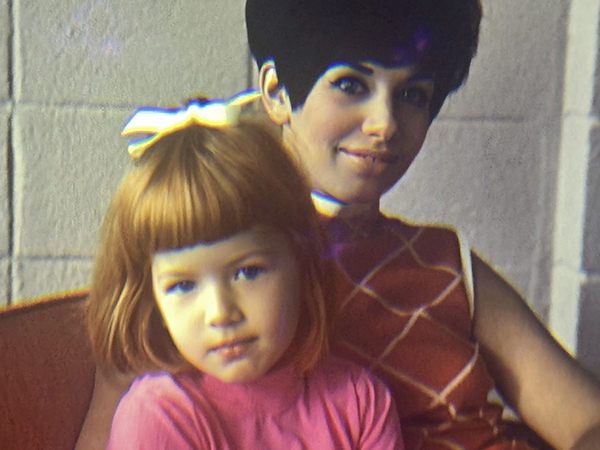
The Little Piano
I once had a music box.
It was a jewelry box shaped like a little piano, its wooden surface painted white and brushed with delicate pastel flowers, each petal fashioned with careful precision. Inside, red velvet lining cradled whatever treasures I tucked away, transforming ordinary trinkets into something precious. The keyboard lifted to reveal a compartment for rings, opening with a softness I can still remember. It sat atop my cream-colored dresser trimmed in burnished gold, catching the morning light as though waiting for the first note to sound.
When wound, it played the Carpenters song, "Close to You.”
To most people, it is a love song—soft, romantic, familiar. To me, it never was.
The song belonged to my mother long before I understood what love songs were supposed to mean. She sang it to me in a voice warm enough to soften any fear, gentle enough to make the world feel safe. When she sang, the room seemed fuller somehow, as though her love occupied every corner.
“So they sprinkled moon dust in your hair of gold and starlight in your eyes of blue,” she crooned, gently twirling my hair or cradling my face in her soft hands.
The music box played the melody in tiny, precise notes, each one arriving exactly when it should. My mother's voice was the opposite. It carried small imperfections—a breath between phrases, a note that trembled slightly, a rhythm that followed feeling rather than measure.
The music box gave me the song.
My mother gave it meaning. “Just like me, they long to be close to you.”
She sang while folding laundry, coloring with me on the sofa, or holding me until I fell asleep. The moments felt unremarkable then. I didn't know they were quietly becoming the memories I would return to for the rest of my life.
I was her shadow.
I watched her apply makeup with effortless grace. I lingered in the kitchen while she measured ingredients and scribbled recipes onto index cards. Most of what she taught me was never spoken aloud. I learned from watching: the care she brought to small tasks, the dignity with which she carried herself, the way she transformed ordinary routines into acts of attention.
She was my north star.
The older I became, the more our differences emerged. She trusted what experience had taught her; I trusted what curiosity might uncover. She valued tradition where I often questioned it. She found comfort in familiar routines while I was restless for change. She was measured and deliberate; I was impulsive and adventurous.
As an adult, we sometimes struggled to understand one another. We could disagree fiercely, each convinced the other was unwilling to bend. Yet my love for her never wavered.
No matter how independent or headstrong I became, I still measured myself against the qualities I admired most in her: her patience, her generosity, her quiet dignity. We were not alike in many ways, but she remained the standard by which I judged character.
Then one day, she was gone.
There is no graceful way to describe the moment a person who has always existed in your world suddenly no longer does.
Pieces of her were everywhere: recipes written in her hand, notes tucked into drawers, phrases I still caught myself repeating. Her presence lingered in countless small places, making her absence impossible to ignore.
In the months that followed, those remnants became anchors: her handwriting, familiar expressions, and traces of her woven through everyday life.
And sometimes, the music box.
When I wound the little piano and heard the first delicate notes, I was listening to an echo. The melody carried me back to evenings when her voice drifted through the house, to moments I had once assumed would last forever.
For the first time, I understood that memories are not only things we keep.
Sometimes they are what keeps us.
Years passed. The little piano remained while so much else changed. It gathered time quietly, becoming less a decoration than a witness.
Eventually, it became something sacred.
I never expected my mother's voice to emerge from its tiny mechanism, yet somehow I heard it anyway—in the spaces between the notes, the silence after the melody ended, and the memories the song carried back to me.
There is something haunting about a music box melody. Stripped of lyrics and voice, it becomes pure feeling. The notes drift through the air like fragments of another life, delicate and distant, as though arriving from somewhere beyond time.
Whenever I heard "Close to You," the world seemed to slow for a moment, making space for memory to step inside.
The older I became, the more the song changed. As a child, it was comfort. As an adult, I came to understand the romantic intention behind the original lyrics. Yet I could never hear it as a love song. Memory had rewritten it. What the songwriters intended as a portrait of romantic devotion had become, in my life, a portrait of unconditional love between parent and child.
That is what music does sometimes. It stops belonging to the world and begins belonging to us.
A song can become a time machine. A single melody can reopen rooms we thought were lost forever and restore, if only for a moment, the feeling of sitting beside someone who loved us completely.
Not every inheritance is tangible.
When I moved out after college, the little piano was packed away with other keepsakes. Years later, it was lost in a flood.
For a time, I mourned it as though I had lost a piece of my mother all over again.
But grief has a way of teaching the same lesson more than once.
The music box was gone, but the song remained.
So did her recipes, her expressions, the habits I learned by watching her, and the values she passed on without ever realizing she was teaching them. What I loved most about her had never been stored inside the little piano. It lived on in the way I moved through the world, in the care I brought to ordinary things, and in the person I became.
I no longer think of "Close to You" as a classic love song. To me, it is the sound of being cared for, the sound of my mother's voice drifting through the house, the sound of childhood before I understood how temporary even the most beautiful things can be.
Perhaps that is why the little piano mattered so much. I once believed it carried a piece of my mother. Only after losing it did I understand that what mattered most had never been inside it at all.
It wasn't playing a song.
It was playing love.
Danielle Barber
Author’s Note: This blog supports a memoir-in-progress. The essays published here stand on their own and do not represent the full narrative, which continues to unfold.