Bread and Bunnies
Growing up in Trenton, Easter meant three things: religion, bunnies, and cured meats—in other words, Catholic, pagan, and sodium.
Even before the first daffodil raised its yellow, bonneted head, Easter preparations took over our house in Trenton. The kitchen filled with the smell of yeast, sugar, and butter, and my mother, Bonnie, stood at the center of it all, sleeves rolled up, orchestrating with the precision of an air traffic controller at the nation’s busiest hub—except her arrivals were loaves, pies, and cakes.
“Don’t touch that,” she warned without turning, as my hand hovered dangerously close to a cooling loaf of my favorite sweet bread. She always knew. Somehow, she always knew.
Easter, second only to Christmas, was a time for very specific baking and cooking. The dishes themselves had traveled a long way—across the Atlantic from the Other Side. (Cue ominous music.) I never understood why we couldn’t just call it what it was: Italy. That’s where my family came from on both sides—some branches more recently than others.
The Other Side sounded less like a place and more like a dimension—not a country, but a portal.
These recipes had a way of pairing ingredients that felt, at best, questionable and, at worst, like a dare. They produced foods that looked one way and tasted entirely different, as if deception were part of the method. Nothing was what it claimed to be.
Loaves resembling innocent pound cake delivered a sharp, aggressive hit of pungent cheese. Pyrex dishes of angel hair pasta floating in what appeared to be Alfredo sauce turned out to be sweet, custardy ambushes. Pies that looked like dessert concealed unsweetened ricotta and bitter shards of orange rind, as though they were actively testing your loyalty. Eating any of it felt less like a meal and more like a trust exercise you hadn’t agreed to.
And then there was pizzagaina—a meal unto itself, a meat pie stuffed with ham, capocollo, prosciutto, pepperoni, Genoa salami, cheeses, and eggs, baked to a golden, glorious finish. It wasn’t so much a dish as a commitment. A lifestyle choice. Possibly a test of character.
Two uncles supplied the meats. Great Uncle Joe cured his in the basement of a corner store in Chambersburg—an unsanctioned outpost of the Other Side tucked into Trenton. No one saw the setup, and no one asked. Easier that way; fewer questions, fewer explanations, fewer chances to accidentally ruin the magic.
Uncle Paul’s father made the finest capocollo I’ve ever had—savory, crusted in black pepper, each slice releasing fat and spice like a tiny, perfect betrayal. Eating it felt like a privilege and a warning all at once.
My grandfather Nello crafted an Easter pasta we called strascinati—though it wasn’t, not really. Our version: penne tossed with eggs, butter, cheese, sausage, and bacon. In other words, all the major food groups.
One year, I ate it for breakfast, lunch, and dinner for two straight days, as if I, too, had fallen under its spell. I kept going until it was gone, scraping and licking the bowl, convinced that sheer devotion might make it replenish itself.
When my grandmother Delphine discovered what I’d done, she was horrified—reacting with two of her signature phrases.
“Ma che ti prende la testa?” What’s wrong with your head?
Then, doubling down in English: “Whatsa matter with you?”
It wasn’t anger, exactly. More like disbelief that a mere mortal could disrespect such potent magic and survive.
Still, my favorite Easter food—by far—was the sweet bread.
Great-Grandma Angelina made her annual ten-block pilgrimage to our house to oversee its production. I called her Grandma Pots and Pans because whenever we visited her home on Hamilton Avenue, I emptied the low cabinets and conducted my own culinary experiments on the shiny green linoleum floor.
Great-Grandma Cecilia, who was legitimately from the Other Side, carried a different kind of authority. She spoke only Italian—the official language of the Other Side. When she spoke gently, no one translated. We just nodded, adjusted, corrected—as if she had issued instructions that didn’t require explanation, only obedience. One misplaced pinch of sugar or errant fold of dough could earn a look that felt like an indictment and a blessing all at once.
Angelina and Cecilia joined my grandmothers and my mother around a massive wooden board set across the kitchen table, kneading dough studded with raisins and, unfortunately, citron. I despised citron. It lurked in the bread like a warning—bright, zesty, and morally judgmental. And though I made my position clear every year, my pleas for citron-free bread were heard, acknowledged, and promptly ignored, as if ignoring me were part of the ritual.
As they worked, the flour-dusted matriarchs gossiped about people in Chambersburg—like Assunta, who wore all her jewelry at once and looked like a fortune teller; Essie, who divided her mother’s estate by literally cutting the living room carpet in half for her sister; and Dorothy, who kept a framed photo of Father Joe on a doily beside her Infant of Prague, perched atop a Zenith TV encased in a wooden cabinet. Everyone had an Infant of Prague.
Ours was a small statue on a side table, impeccably dressed thanks to Angelina, a bridal dressmaker who crafted elaborate robes from satin, velvet, lace, and gold embroidery. Occasionally, when no one was looking, I borrowed the robes to dress my Barbies, who were the same size. Haute couture. Possibly sacrilegious. Definitely magical.
Then came the moment I’d waited for all night—the climax, the denouement, the reason the kitchen itself seemed to hold its breath. Just before the dough was divided and set to rise, a reverent hush fell over the room, thick enough to taste. Even my father and grandfather muted Wide World of Sports in the living room, as if they, too, sensed the gravity. This was no ordinary baking. This was a ritual, a reckoning, and everyone knew it.
From my vantage near the hutch, I watched the dough tremble under Angelina’s hands, as if aware of the ceremony. Tiny flour-dusted shivers ran through its surface. When she murmured the prayer, it seemed to inhale, rising slightly in anticipation. And then—KA-BOOM!
She drove a right hook into the center of the dough, sending a small cloud of flour skyward. The bread quivered, shuddered, even seemed to sigh, as though it had known the touch of a master all along. When she made the sign of the cross, it stilled, almost bowing under her palm. I didn’t understand it, but I knew it mattered. The sweet bread was alive, and we were merely witnesses.
Years later, I asked my ninety-year-old Grandma Mary where the tradition came from. She smiled, as if sharing a secret too old to question, and said it was simply something they had to do. No explanations, no justifications, just devotion handed down like a quietly magical heirloom.
Whether it was divine intervention, culinary mastery, or that holy right hook, the bread was always perfect. Toasted with butter, made into sandwiches with basement meats, dunked in coffee, smeared with cream cheese late at night—the possibilities felt endless. And of course, I meticulously picked out the citron and got it everywhere, like a tiny, zesty rebellion against centuries of solemn tradition.
“Whatsa matter with you?” Delphine would ask.
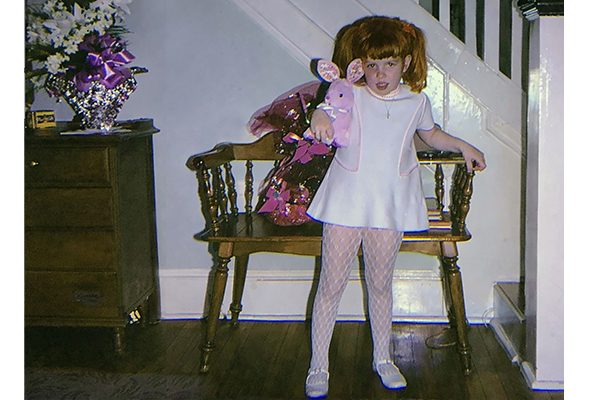
Easter morning brought a massive, decadent basket on the telephone bench: cellophane-wrapped, ribboned, brimming with towering chocolate rabbits and lambs, crème-filled eggs, marzipan carrots, and, of course, chocolate crosses—which looked faintly out of place beside the bunnies. Beside it sat a plush bunny and a small religious gift. Pagan and sacred, side by side.
After covert candy binges came the ricotta-and-sausage frittata breakfast, then Easter Mass, where my father and I lolled in a sugar coma, having indulged far too much pre-meal chocolate. To stave off the inevitable crash, I flipped through the hymnals, watching my mother’s jewelry glint under the church lights, each gem scattering tiny sparks that danced across the pews like mischievous sprites.
My father sang the hymns operatically to make me laugh—and it worked, too well. Giggles bubbled up uncontrollably, until my mother silenced us with a single look, her violet-blue eyes narrowing into twin daggers. Even the chocolate rabbits might have quivered in fear.
After making the rounds for more Other Side delicacies, we retreated home, sated and swollen, for the inevitable viewing of The Ten Commandments. The Angel of Death terrified me every year, shadowy smoke drifting down, filling the streets. I pressed close to my father, urging him to mark our door with lamb’s blood, just as the Jews had in Egypt, hoping it might persuade the Angel to pass us by.
Always good-natured, Joe reassured me we had nothing to fear—we weren’t Jewish, and I wasn’t a firstborn son. My grandmother cut in: “This—every year. Whatsa matter with both of you?”
Now Easter is quieter. Too quiet. The bonnets, the bakeries, the basements, the matriarchs—all of it has faded into memory. Only now do I understand how fortunate I was to have those women in my life. And though I’ve visited Italy many times, the Other Side feels farther away—its rituals less urgent, its emissaries gone.
Still, one plush Easter bunny remains, a small sentinel of the sugar, laughter, and chaos that once filled our house—a relic, perhaps, from both worlds. Once white, with blue gingham ears, Him-Him is now threadbare from too many washings, rosary beads looped around his neck.
Don’t ask.
Danielle Barber
Author’s Note: This blog supports a memoir-in-progress. The essays published here stand on their own and do not represent the full narrative, which continues to unfold.