
The Calling
Twelve years of Catholic school may sound daunting to some. A strict, serious, pious, and pure environment is not for the faint of heart. Though I've often joked about those years with exaggerated taglines—The Academy of Guilt and Grammar, Our Lady of Perpetual Homework, or The Sister Act Prequel—the experience was profoundly formative in ways I wouldn't understand until much later.
I have always been fascinated by religion—captivated by its statues and ceremonies, wide-eyed with wonder. The church felt full of mysteries just beyond my reach. I loved the way stained-glass windows transformed ordinary sunlight into jeweled colors. As a child, I didn’t have the language to explain it, but I was endlessly curious about the invisible world the adults spoke of with such certainty.
Kindergarten at Ireland Private School on Chestnut Avenue in Chambersburg was my first and last experience in a co-ed classroom until college. Convinced that an all-girls private school would offer the best education, Bonnie and Joe set their sights on Villa Victoria Academy.
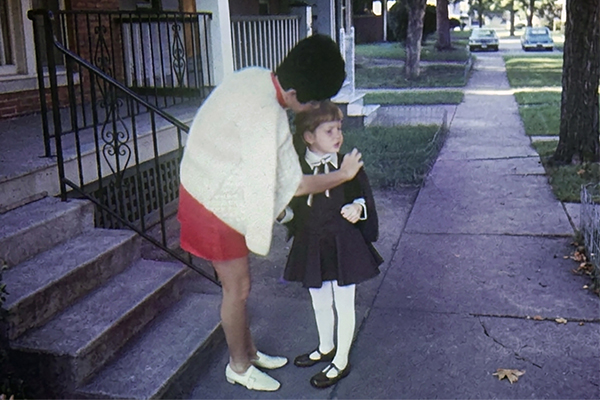
And so, one fine day, we drove the seven miles from our house in Trenton along Route 29 to the school’s bucolic campus, nestled on the grounds of a former estate, for my very first admissions interview. Bonnie always got the assignment, and she dressed me in brown—the color of the school’s grammar school uniforms.
“Ready, kiddo?” my father asked as we parked his brown Buick sedan in front of the large mansion that housed the convent, where we were about to meet Sr. Gloria, the lower school principal.
I was very anxious as my mother smoothed my hair one last time. Perhaps it is anxiety that fixes certain memories in place, preserving them with unusual clarity.
“Now remember, answer whatever Sr. Gloria asks you.”
What would she want to know? My favorite game? My favorite color?
Would she ask about my secret crush on Captain Scarlet, the dashing hero of a British puppet television series? Whenever the show came on, I changed into black and red clothes to match his uniform. To me, devotion to a marionette seemed perfectly reasonable.
The convent had a distinct smell—a kind of Lemon Pledge formality that seemed to announce order, discipline, and purpose. We sat at a large table, perhaps in the dining room. I remember the dark wood gleaming beneath fingers of sunlight filtering through heavy drapes. Dust motes floated in the beams like tiny planets suspended in their own universe. The room was quiet, almost reverential, and to my five-year-old mind it felt less like an office than a place where important decisions were made and futures quietly set into motion.
Pleasant-faced and warm, Sr. Gloria immediately put me at ease. She wore a simple black dress that fell just below her knees and a black bonnet-like head covering that revealed a band of white hair above her forehead. What I noticed most, though, were her kind eyes. She smiled easily and spoke gently, and before long I forgot to be quite so nervous.
The religious teachers at Villa belonged to the order founded by St. Lucy Filippini, though at five years old I knew almost nothing about saints and even less about what it meant to belong to a religious order.
“Your parents tell me you’re an artist,” she said softly, smiling across the table. “What do you like to draw?”
Bonnie and Joe sat opposite me, proudly bookending their nervous daughter.
“S-s-snoopy,” I managed.
The adults laughed gently, and I felt the tension drain from my shoulders.
Truthfully, I could have drawn Snoopy all day long. Fifty years later, not much has changed. Snoopy still appears in sketchbooks and on scraps of paper whenever a pen is within reach. Some first loves never really leave us.
Sr. Gloria explained that she had joined the religious order when she was very young because she had received “the calling.”
It was sheer coincidence that shortly afterward, the black rotary phone on a doily-covered side table rang.
I don’t remember much more of the interview, but that September Joe, Bonnie, and I returned for my first day of first grade. That very first day, I met Amy and Margaret, both of whom remain dear friends to this day. I had no idea then that Villa would introduce me to a steadfast group of women who would become mirrors of those years and witnesses to my life.
I was surprised that not all the teachers were nuns. There were also lay teachers, and in first grade I had one: Miss Mustee.
She was the consummate cool woman of the early school years. She wore short dresses and tights, heels clicking down the hallway with an easy confidence that made her feel like she belonged to a different, more modern world.
In classes and assemblies, I often heard the religious teachers speak about how they had received The Calling, as if it were something both ordinary and extraordinary at once. It was mentioned with such calm certainty that I began to think it must be a real, unmistakable event—the phone ringing in the middle of your life that you were expected to answer without hesitation. Like it had on the day in the convent.
Though I excelled in my classes and genuinely admired my teachers, I grew increasingly wary of it. I was young, but I knew one thing unequivocally: I did not want to be a nun.
I liked my house. I liked my toys. I liked the colorful clothes I got to wear. I liked the ordinary freedoms of childhood—the ability to change my mind, to run outside, to lose myself in play without wondering whether I was being summoned toward something larger and more irreversible.
Miss Mustee didn’t talk about The Calling. She didn’t seem to be waiting for anything at all. She seemed happy, free, unbothered by telephones, divine or otherwise. Maybe she hadn’t gotten The Calling. Or maybe she simply hadn’t picked up.
Then it dawned on me. That was what I would do.
I would avoid The Calling.
I simply wouldn’t answer the phone.
And so it began.
“What’s the matter with you?” Delphine would call from the kitchen, her voice rising whenever I bolted at the sound of the olive-green wall phone. “Pick up! Can’t you see my hands are in pizzelle dough?”
“Oh, leave her alone, Del,” Nello would say, without looking up.
But I was already gone.
I ran past the living room phone perched on its small wooden bench like an unattended witness. I jumped off my mother’s bed whenever the powder-blue phone on her dresser rang, the sound suddenly sharp and accusatory.
If I didn’t answer, I wouldn’t get The Calling.
At dinner. At night. In the middle of play, I became fluent in avoidance.
I leapt over sketch pads and scattered colored pencils, abandoning Barbie mid-outfit change. I sprang from the sofa beside my father while he quizzed me on vocabulary words. I disrupted my grandfather’s Sunday newspaper ritual, the rustle of newsprint giving way to my sudden flight whenever the phone rang.
Every ring was a summons. Every ring a test.
All I could think was: don’t pick up. don’t pick up.
It wasn’t long before my mother caught on.
At first she tried to let it pass. Parents do that—wait for things to resolve themselves, assuming reason will eventually win out over whatever private logic a child has constructed. But my behavior didn’t soften. It escalated. I treated every ringing phone like a fire alarm. I disappeared mid-sentence, mid-game, mid-life.
Finally, she stopped me mid-run.
“What is going on?” Bonnie asked, hands on hips, looking at me with a mixture of concern and disbelief. “Why are you so terrified of the phone?”
I hesitated, searching for the right words. Because if I answered it, I might get The Calling. That was all I had.
She stared at me for a moment. Then her expression shifted—just slightly, the way adults’ faces do when they realize they are not dealing with fear, but misunderstanding.
“The calling?” she repeated slowly. “What calling?”
I nodded, serious. “The Calling. From God.” Then I explained about the nuns.
There was a beat of silence.
And then, very carefully, as if correcting a minor but important error in the universe, she said, “No, angel. That’s not how it works. That’s just the phone.”
For a moment, no one moved.
I tried to absorb this new information, as if it might rearrange itself into something familiar if I looked at it long enough.
And then my mother laughed and drew me close. Her warmth and signature Shalimar perfume enveloped me. Hugging me tightly, she repeated, “The phone… the phone.”
My father laughed too, leaning back like the whole scene had finally resolved into something familiar again.
Even I laughed, eventually—though more slowly, as the system of meaning I had built quietly gave way.
After that, the phone rang the way it always had. I answered it.
At the time, I had more pressing concerns—like changing into black and red whenever Captain Scarlet came on television.
Years later, I learned that callings rarely arrive the way we expect them to. Mine found me anyway.
Danielle Barber
Author’s Note: This blog supports a memoir-in-progress. The essays published here stand on their own and do not represent the full narrative, which continues to unfold.