
Forever Bonnie
My mother entered the world the way she would move through it—decisively, dramatically, and entirely on her own schedule.
It was a mild spring day, a date that already belonged to someone else: her mother. After nearly two relentless days of labor, my grandmother Delphine delivered her first child on her own birthday. I have always loved that detail. It feels symbolic, as though my mother claimed the day with a flourish, announcing with her first breath that she would not be rushed, redirected, or overshadowed.
Family lore insists she was a vision. Delicate and luminous, with pale skin and soft golden hair, she resembled less a newborn than something rendered in fresco—an angel lifted from a cathedral ceiling. The struggle that ushered her into the world left no visible mark. She appeared untouched by effort. Serene. Immaculate. Already aware of herself.
My grandfather, Nello, was enchanted. A gentle man, he had been spared military service during World War II because of a hearing impairment. Instead, he worked steadily, saved diligently, and by his late twenties had purchased a home for $6,000—a small fortune at the time. He was ready for fatherhood. Ready for this child.
He wanted to name her Cecelia, after his own mother, who had emigrated from Italy years earlier. Though it may not have been my grandmother’s first choice, she agreed. Diane was tucked in as a middle name. And so the baby left the delivery room as Cecelia Diane.
But that name would not stick.
In those days, new mothers remained in the hospital far longer than they do now. During my grandmother’s extended recovery, a nurse was assigned to help with the baby—a Scottish woman with a mellifluous brogue. According to family legend, she was tall and striking, her crisp white uniform so sharply starched it almost shimmered blue. Dark hair was pinned flawlessly beneath her cap.
She took one look at the infant and exclaimed in a lilting brogue, “What a bonnie baby!”
She explained that bonnie meant “beautiful” in Scottish. The word floated through the maternity ward and caught. Within days, the baby was no longer Cecelia to the staff. She was the bonnie baby.
Bonnie.
And just like that, a name shifted. A life subtly redirected by a stranger’s affectionate remark.
I have often wondered about that nurse—about how casually she altered the course of my mother’s identity. Would a Cecelia have grown into the same woman? It is impossible to know.
I have sometimes wondered whether my great-grandmother ever took offense that her own name was unceremoniously bumped aside by a Scottish adjective. Though Cecelia was always her legal name, most people knew my mother only as Bonnie.
Names carry weight. They create expectations. Bonnie suggests brightness and openness—exactly what my mother became. The name fit. It fit because she was beautiful. Arrestingly so.
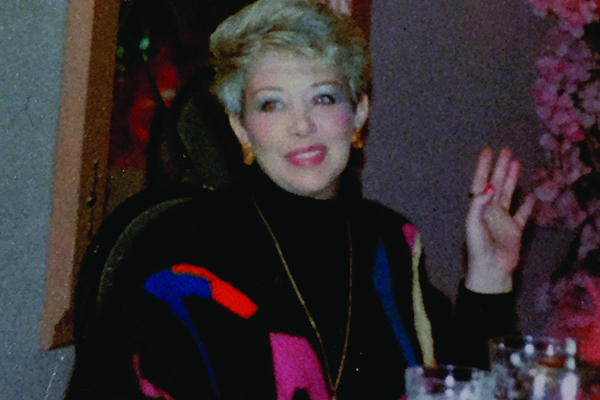
Her skin remained luminous long after time should have laid claim to it. She possessed a beauty that was not fleeting but sustained—prettiness refined into something enduring. A hairdresser by trade and an artist by instinct, she treated her own reddish-brown hair as a canvas, transforming it first into a lacquered blue-black, and years later into a pale, arresting blonde. Both extremes suited her flawlessly, as though color itself deferred to her certainty. Her features were fine and deliberate, and her eyes—an improbable violet-blue—were the kind strangers struggled to name without borrowing from Elizabeth Taylor.
Strangers stopped her regularly. In grocery stores, beside pyramids of oranges. On sidewalks where traffic roared indifferently past. In waiting rooms heavy with fluorescent light and impatience. They interrupted her solitude to comment on her face, as if beauty were public property and gratitude required an audience. She accepted it graciously, though never greedily. Admiration neither embarrassed nor inflated her. It simply passed through her.
Yet for all her glamour, she hated photographs. The moment a camera appeared, she stiffened slightly, as though something private had been breached. She would lift a hand, laugh it off, or turn her face just enough to spoil the frame. “Oh, stop,” she’d say, half amused, half insistent. “I don’t like to be in pictures.” She simply couldn’t fake it.
Which makes the few that exist feel almost accidental. Posing for photographs was rare, and when she did allow it the smile never quite settled naturally on her face. The candids—the ones she never knew were happening—are my treasures.
And then there was me.
I did not inherit her porcelain refinement. Where she was ethereal, I was substantial. Where she glowed, I flushed. My skin reddened at the slightest hint of emotion and rebelled in adolescence with theatrical persistence. I grew tall and broad-shouldered, built not from air and light but from sturdier material, like my father. My hair resisted discipline with a will entirely its own.
Once people finished admiring her, they would remember that I was standing there.
“Oh. Hello.”
It became our private theater, a performance staged for two. Once beyond earshot, we would collapse into laughter, shoulders shaking, dignity abandoned. Sometimes we had to steady ourselves against a car door or a grocery cart, wiping tears that blurred our mascara.
And always—always—she would turn to me with sudden seriousness, as though the laughter had only cleared the air for something sacred. She would hold my face in her soft, manicured hands and look at me with an intensity that made retreat impossible. In that violet-blue gaze there was only conviction. She would tell me, with absolute certainty, that I was more beautiful than she had ever been.
She was wrong.
But the truth of it never mattered. What mattered was that she believed in me with the same certainty she brought to everything in her life. Her beauty may have opened doors, but it was her certainty that carried her through them.
She entered the world on her own terms and spent the rest of her life doing exactly the same. And I was proud—so fiercely proud—that of all the remarkable things she was, she was mine.
Bonnie.
Forever.
Danielle Barber
Author’s Note: This blog supports a memoir-in-progress. The essays published here stand on their own and do not represent the full narrative, which continues to unfold.